
War, Inflation, and Your Education: How Global Conflicts Affect Forex and Living Costs
- May 1, 2026
- Posted by: Aditti Gupta
- Category: Uncategorized
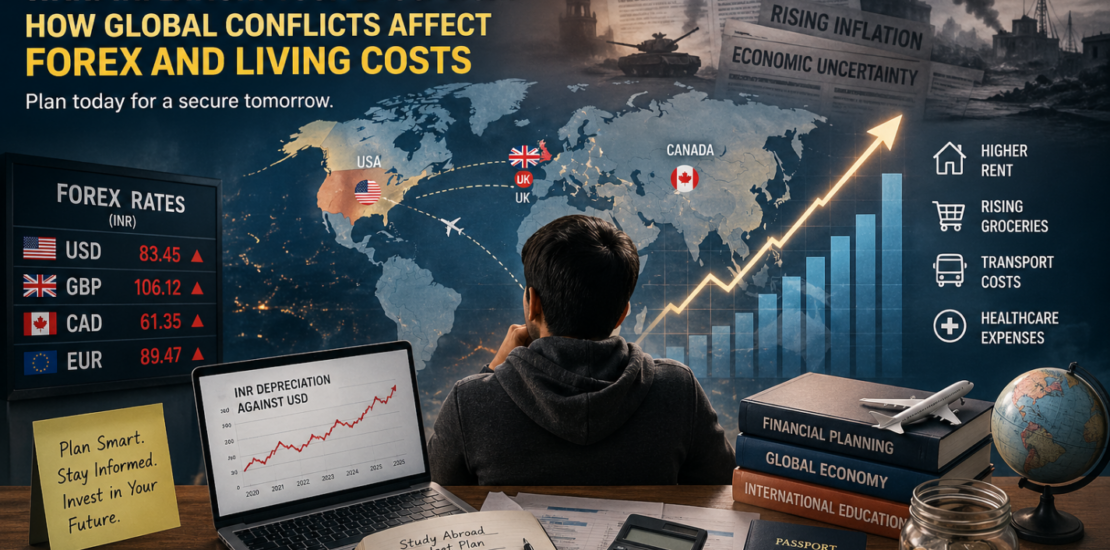
For many Indian families, studying abroad is one of the most important investments they will ever make. It represents not just education, but a long-term vision for career growth and global exposure.
However, in today’s world, this decision is no longer influenced by academics alone.
Global events—such as wars, rising inflation, and economic uncertainty—are now directly affecting the cost and financial planning of studying abroad.
This raises an important and practical question:
How do global conflicts impact your education budget?
Understanding this is essential before making any major decision.
How Global Conflicts Affect Currency (Forex Rates)
When conflicts arise globally, financial markets become unstable. Investors move funds toward stronger economies, which often leads to a weaker Indian Rupee.
According to reports from The Economic Times, fluctuations in the rupee have already increased the cost of studying abroad for Indian students.
What This Means for Students and Parents
- Tuition fees become more expensive when converted to foreign currencies
- Living expenses increase without any change in actual prices abroad
- Overall budget requirements rise unexpectedly
Even small fluctuations in exchange rates can increase your total cost by ₹2–5 lakh or more over time.
This is why forex awareness has become a key part of study abroad planning.
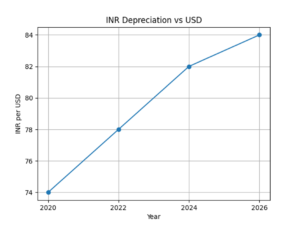
Figure (a): INR depreciation against USD and its impact on education costs
The Impact of Inflation on Living Costs
Global inflation, monitored by institutions like the International Monetary Fund, has significantly increased everyday expenses across major student destinations.
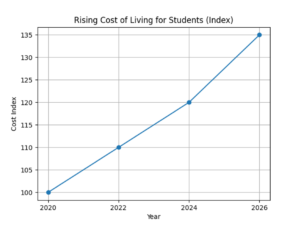
Figure (b): Rising cost of living trends for international students (2020–2026)
Key Areas Where Costs Have Increased
- Accommodation and rent
- Food and groceries
- Transportation
- Healthcare and insurance
Current Reality in 2026
- Students now spend approximately ₹10–15 lakh per year on living expenses
- Cities in countries like the UK and Canada have seen noticeable cost increases
What used to be manageable budgets earlier now require careful and realistic financial planning.
How Economic Uncertainty Affects Career Outcomes
Global instability also impacts job markets. According to insights from the World Bank:
- Hiring trends may slow down during uncertain periods
- Competition for jobs increases
- Work visa policies may become stricter
What This Means
While opportunities still exist, students must now:
- Be more prepared
- Focus on skill development
- Plan their career path early
The margin for error has reduced, but opportunities are still strong for well-prepared students.
Rising Cost of Education: A New Reality
Apart from living expenses, tuition fees have also increased due to:
- Inflation in operational costs
- Higher global demand for quality education
- Currency fluctuations
Average Investment in 2026
- Total cost: ₹20 lakh to ₹50 lakh+
This makes studying abroad a significant financial commitment that requires structured planning.
Which Countries Are More Affected?
Higher Cost Pressure
- UK = Higher living costs
- Canada = Rising rent and policy changes
- USA = Strong dollar impact
Relatively Stable Options
- Germany → Low or no tuition fees
- Select European countries → Controlled living costs
Choosing the right destination is now more important than ever.
How Students Are Making Smarter Decisions Today
A clear shift is visible in how students and parents approach this decision.
Earlier decisions were based on:
- Popular destinations
- Peer influence
- University rankings
Today, decisions are based on:
- Total cost vs expected return
- Career opportunities
- Long-term stability
This reflects a move toward informed and responsible decision-making.
How to Manage These Risks Effectively
While global factors cannot be controlled, their impact can be managed with the right approach.
Practical Steps
- Plan a financial buffer of at least 10–15%
- Choose courses with strong career demand
- Stay informed about forex trends
- Prioritize countries with better work opportunities
Careful planning can significantly reduce financial stress.
A Balanced Perspective: Should This Be a Concern?
Global conflicts and inflation should not discourage students but they should encourage better preparation.
Studying Abroad Still Works Well When:
- Planning is structured
- Financial decisions are realistic
- Career goals are clearly defined
It Becomes Risky When:
- Decisions are rushed
- Costs are underestimated
- Career planning is ignored
The PPRO EED Approach: Guidance Built on Experience and Trust
At PPRO EED, the focus has always been on providing accurate, transparent, and practical guidance to both students and parents.
With years of experience, the approach goes beyond admissions:
- Understanding each student’s goals
- Evaluating financial feasibility
- Recommending the right country and course
- Preparing students for long-term success
The goal is simple:
To ensure that every decision is informed, realistic, and aligned with the student’s future.
FAQs
1. Do global conflicts directly affect study abroad costs?
Yes, they influence currency exchange rates, inflation, and job markets.
2. Why is forex important for students?
Because even small currency changes can significantly impact total expenses.
3. How much has the cost increased in recent years?
Living expenses and overall budgets have increased noticeably, often requiring ₹10–15 lakh per year.
4. Is it still safe to plan studying abroad in 2026?
Yes, with proper planning and guidance, it remains a strong opportunity.
5. Which countries are more affordable?
Germany and some European countries offer more cost-effective options.
6. How can families reduce financial risk?
Through early planning, budgeting, and choosing the right course and destination.
Conclusion
The global environment has changed, and with it, the way we approach international education.
Studying abroad is no longer just about opportunity, it is about awareness, preparation, and smart decision-making.
For families who take a structured and informed approach, it continues to offer valuable long-term benefits.
And with the right guidance, it can remain a safe and rewarding investment in a student’s future.