
Decoding the 2026 Visa Rules: What the “National Caps” Mean for Your Application – UK, Canada, Australia visa changes — simplified
- August 12, 2026
- Posted by: Aditti Gupta
- Category: COUNTRIES
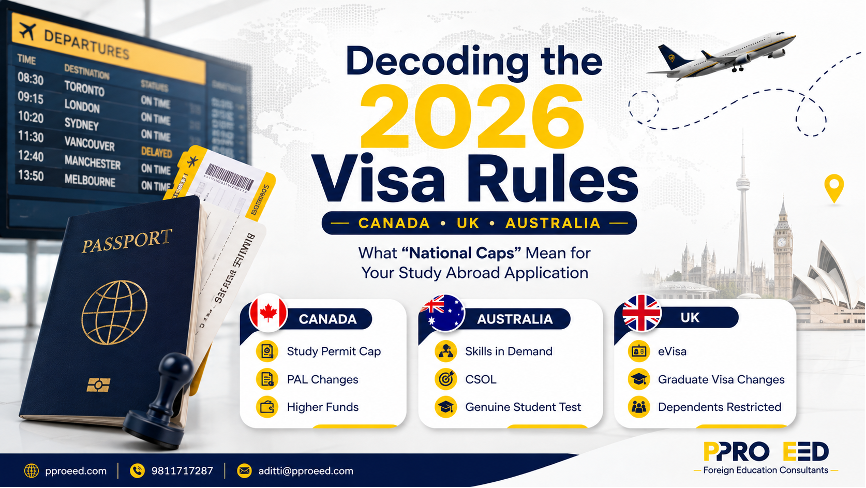
If you’ve been planning to study abroad, here’s the headline from 2026: countries aren’t necessarily closing their doors, they’re just getting a lot more selective about who walks through them.
Canada, Australia, and the UK are all still welcoming international students. But each has tightened its rules in its own way — some to ease housing pressure, some to align education with labour shortages, some simply to close loopholes that had built up over the years. The common thread? It’s no longer enough to just get admitted. Governments now want to see that you’re financially prepared, academically serious, and headed toward something the country actually needs.
Here’s what’s actually changed, country by country, and what it means for your application.
Canada: The Most Aggressive Shift Yet
Canada hasn’t been subtle about this. For 2026, Immigration, Refugees and Citizenship Canada (IRCC) has set a study permit target of 408,000 — down from 437,000 in 2025 and 485,000 in 2024. This is a deliberate, multi-year pullback aimed at slowing temporary resident growth while still making room for high-value talent.
A few things every applicant needs to know:
The Student Direct Stream is gone. SDS used to fast-track applications for eligible students from select countries — that option no longer exists. Everyone now goes through the standard study permit process, and timelines vary depending on your country and current application volume. Translation: apply earlier than you think you need to, and don’t trust old blog posts or forum advice that still reference SDS timelines.
Graduate students have a real edge. Most undergraduate and college applicants still need a Provincial or Territorial Attestation Letter (PAL/TAL) before they can even submit a study permit application — one of the biggest bottlenecks in the whole process. Master’s and PhD applicants heading to public Designated Learning Institutions skip this requirement entirely, which meaningfully speeds things up.
Proof of funds has jumped. A single applicant studying outside Quebec now needs to show CA$22,895 in living expenses, on top of first-year tuition and travel costs. If you’re working from a figure you saw a year or two ago, update it — applications built on outdated numbers risk refusal.
PGWP eligibility is now tied to what Canada actually needs. If you’re in a college-level or non-degree program, your Post-Graduation Work Permit eligibility now depends on studying in a field connected to long-term labour shortages — healthcare, STEM, education, agriculture, transport, or skilled trades. Bachelor’s, master’s, and doctoral graduates are exempt from this requirement.
Permanent residency still favours skilled workers. Even as temporary resident numbers shrink, Canada’s 2026–2028 Immigration Levels Plan keeps its focus on economic immigration, aiming to bring temporary resident growth below 5% of the population by 2027.
Bottom line: Canada is still one of the strongest study destinations in the world, but the margin for error has narrowed. A solid financial profile, an early application, and a program that lines up with labour market priorities will do more for you now than ever. Right now, graduate applicants have the clearest structural advantage.
Australia: Growth, But With Guardrails
Australia has taken a different path than Canada — not a sharp cutback, but tighter control paired with continued growth.
Planning levels are managed, not slashed. Australia has introduced a national planning framework for international student commencements, balancing enrolment growth against housing capacity and infrastructure. For 2026, reports point to roughly 295,000 planned student commencements, up from around 270,000 the year before — though how this plays out will keep evolving across individual institutions.
A new visa has replaced the old one. The Temporary Skill Shortage (TSS) visa is gone, replaced by the Skills in Demand (SID) visa — a system designed to respond more directly to what employers actually need, making it easier to recruit overseas professionals whose skills match current shortages.
The Core Skills Occupation List (CSOL) is now central to everything. If staying in Australia after graduation is part of your plan, check whether your intended profession is on the CSOL before you choose a course. This single step can save years of uncertainty down the line.
Scrutiny has gone up across the board. Expect higher English-language benchmarks, more financial evidence requirements, stronger “genuine student” assessments, and no more switching from a visitor visa to a student visa while you’re inside the country.
Skilled migration remains the priority. The bulk of places in Australia’s permanent Migration Program continue to go toward occupations that support economic growth and address workforce shortages.
Bottom line: Australia is still relatively open to international students, but success now hinges on choosing a qualification tied to what the country’s workforce actually needs. Check the CSOL early — it should shape your course choice, not come as an afterthought.
United Kingdom: More Verification, Fewer Loopholes
The UK hasn’t set a single headline cap the way Canada has. Instead, it’s tightened compliance across the board — dependents, employer sponsorship, and digital immigration systems all look different in 2026.
Bringing family along just got harder. Most students on taught master’s programmes can no longer bring dependents, unless they’re enrolled in a research programme or have government sponsorship. If you were planning to move with a partner or children, this changes the math significantly — plan around it early.
Immigration is going fully digital. Physical Biometric Residence Permits are being phased out in favour of eVisas, so your immigration status will increasingly live online rather than on a card in your wallet. Make sure you understand how to access and manage that digital record before you travel.
Employer compliance is under a much brighter spotlight. Sponsors hiring overseas workers under the Skilled Worker route now face stricter salary and reporting requirements. If you’re pursuing work-based immigration, your employer’s compliance record matters more than it used to — a shaky sponsor can now become your problem too.
Graduate visa duration is shrinking too
Alongside these changes, the UK’s post-study work route is getting shorter. The Graduate visa currently allows international students to stay and work in the UK for 2 years after finishing a bachelor’s or master’s degree (3 years for PhD graduates). Following the May 2025 Immigration White Paper, the Home Office has confirmed — via a Statement of Changes laid in October 2025 — that this will drop to 18 months (1.5 years) for non-PhD graduates applying from 1 January 2027 onward. Applications submitted on or before 31 December 2026 will still receive the full 2-year period; PhD graduates remain unaffected at 3 years.
For students planning their post-study work timeline, this means the window to secure sponsored employment or transition to a Skilled Worker visa is narrowing — making early job planning even more important for anyone graduating from 2027 onward.
A new “Visa Brake” targets a small number of nationalities. As of March 2026, the UK introduced a mechanism that temporarily restricts certain visa routes for nationals of countries with unusually high post-arrival asylum claim rates — currently Afghanistan, Cameroon, Myanmar, and Sudan, affecting some Student and Skilled Worker routes.
Costs remain high. Visa fees, the Immigration Health Surcharge, accommodation, and living expenses all need to be budgeted for well in advance — there’s no shortcut here.
Bottom line: The UK still draws huge numbers of international students, especially at top universities. But expect more paperwork, fewer family sponsorship options, and a fully digital process from application to arrival.
The Pattern Behind All Three
Look past the country-specific details and one trend is impossible to miss:
– Canada is shrinking its overall numbers while rewarding graduate students and priority occupations.
– Australia is growing carefully, but tying that growth tightly to labour market needs.
– The UK isn’t cutting numbers so much as closing loopholes and digitising everything.
The days of “apply now, figure it out later” are over. The applicants who come out ahead in this new landscape are the ones who:
- choose a program aligned with labour market demand,
- get their financial documentation right the first time,
- understand the current rules before they apply, rather than after a refusal, and
- think about their career pathway, not just their acceptance letter.
All three destinations still offer genuinely excellent education and career opportunities — but the room for a weak or unprepared application has shrunk considerably. Strategic planning isn’t optional anymore. It’s the whole game.
Immigration policy changes frequently, and individual circumstances vary. This article reflects the visa rules current as of mid-2026 — always confirm the latest requirements with the relevant immigration authority or a licensed adviser before you apply.